Hybrid Retrieval for AI

Beyond Vector Search: Why Enterprise AI Needs Both Text-to-SQL and RAG
If you’ve ever tried asking a corporate chatbot a question like "What was our Q3 EBITDA margin expansion, and why did logistics costs spike?", you've likely hit a familiar wall.
A standard vector-search (RAG) system will hallucinate or struggle with the exact mathematical calculation. Meanwhile, a traditional SQL query will return precise financial totals but leave out the human context explaining why those numbers moved.
This is The Enterprise Data Dichotomy: quantitative metrics live in structured relational databases, while strategic rationale lives in unstructured document repositories.
My solution to this was engineering a unified Hybrid AI Retrieval and Research System in a recent project.
How Hybrid AI Retrieval Works
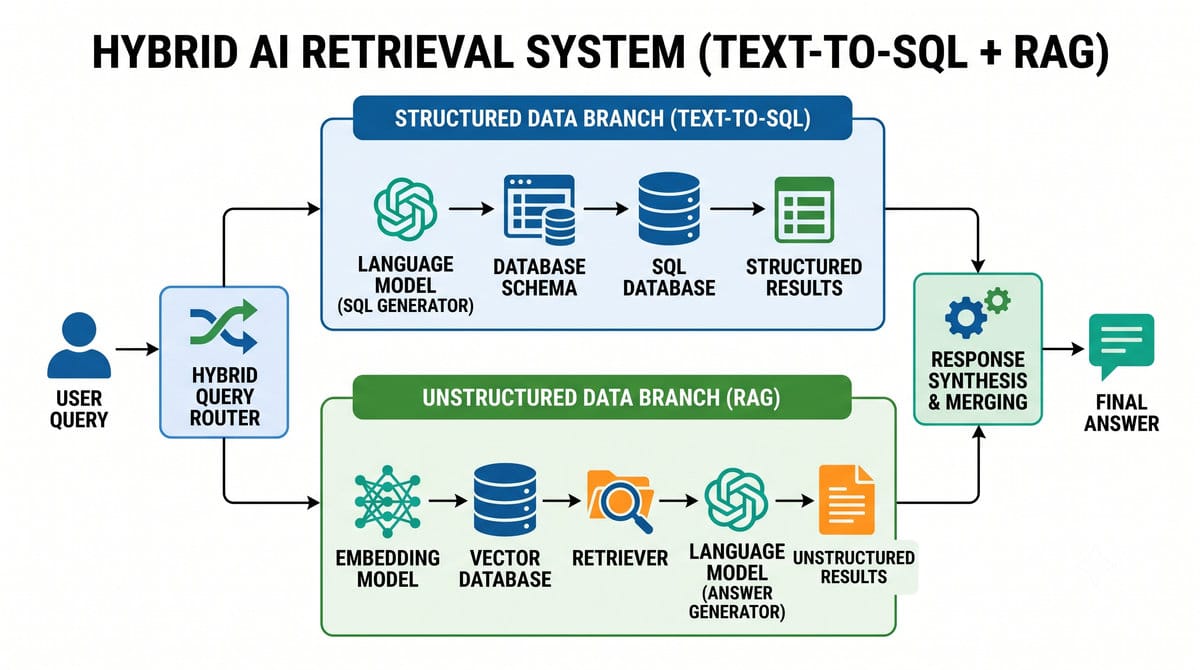
Instead of forcing all queries through a single AI pipeline, the system uses an intelligent Context & Intent Router to dynamically split and route queries:
- Text-to-SQL Engine: Handles complex aggregations, date filters, and multi-table database queries with actual data, not hallucinations.
- RAG Engine: Searches PDFs, earnings transcripts, and policy documents using context-aware chunking and cross-encoder re-ranking.
- Dynamic Router: Identifies user intent in real-time, executing SQL and vector searches concurrently before synthesizing a single, fully grounded answer with dual attribution.
Why It Matters for Executives & Operators
By bridging structured databases and unstructured context, enterprises can finally execute complex, dual-domain research in seconds; whether auditing regulatory compliance, analyzing vendor SLA terms, or building executive reporting packages without numerical hallucination.
Want a Deep Dive into the Architecture?
Take a look at the case study at jaykayenn.com